Why Gut Decisions Don’t Scale And How to Scale Business Decisions Instead
In the early days of a company, instinct often feels enough. With a small team and personal oversight, decisions can be made quickly, based on experience and gut feel. But as any business leader knows, growth changes everything.
More customers. More staff. More moving parts. Complexity compounds fast, and relying on intuition becomes less a strength and more a risk. Decisions made without clear visibility lead to missed opportunities, wasted resources, and stalled momentum.
That’s why growing companies need to scale business decisions with systems and data- replacing gut feel with visibility, efficiency, and confidence. Today, companies that continue leading from the gut are increasingly outperformed by those that lead from data.
The Evidence: Data-Driven Businesses Outperform
Research from the MIT Center for Information Systems Research highlights that companies leveraging real-time data report 62% higher revenue growth and 97% higher profit margins than those that don’t (Weill et al., 2024).
Harvard Business School Online (2024) reinforces this point, identifying data-driven decision-making as a critical advantage in modern business strategy, arguing that leadership decisions based on evidence, not assumptions, deliver sustained performance gains.
Meanwhile, a study by RT Insights (2024) found that businesses incorporating real-time reporting systems see up to 79% improvement in business outcomes and 15% higher revenues within just twelve months.
And the latest figures from AnaVo Growth (2024) reveal that businesses leveraging actionable, real-time insights reduce operational costs by up to 10%, while improving margins by 8%.
Despite this, fewer than 25% of businesses describe themselves as truly data-driven (Harvard Business School Online, 2024).
Steps to Scale Business Decisions for Growth
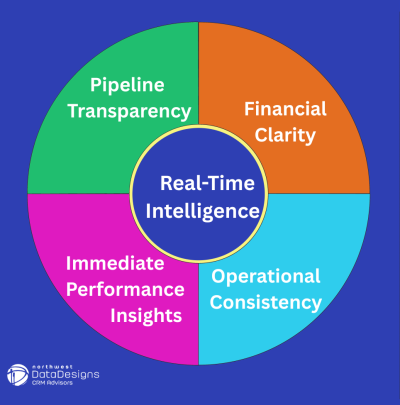
While “data-driven” is often linked with complexity, real-time reporting performs a simple task: it eliminates uncertainty. Businesses operating with live, accurate data, gain four practical, operational benefits:
Pipeline Transparency: Real-time visibility into your sales, production, and delivery pipelines means leaders can see exactly what’s moving, what’s stuck, and what’s closing. Forecasting becomes clearer, and priorities become actionable.
Financial Clarity: Instant access to revenue streams, expenses, and cash flow allows leadership to act without waiting for end-of-month reports. Decisions are based on facts, not guesses.
Immediate Performance Insights: Operational bottlenecks, sales trends, and team output become visible as they happen. Leaders can identify issues early and address them before they turn into costly problems.
Operational Consistency: Data standardizes processes. Workflows transition from being people-dependent to being process-driven, enabling sustainable growth without sacrificing quality or reliability.
These four pillars: Pipeline Transparency, Financial Clarity, Immediate Performance Insights, and Operational Consistency, are what enable growing companies to move from reactive to proactive leadership.
Building a Real-Time Business: The Four Core Capabilities
MIT CISR’s 2024 report identifies four critical capabilities that separate real-time businesses from their competitors:
- Instant Data Flow: Decisions based on live, shared data.
- Seamless Customer Experience: Consistency powered by unified systems.
- Organizational Agility: Faster decision-making across all levels.
- Employee Empowerment: Teams act confidently from a single source of truth (Weill et al., 2024).
It’s not about advanced analytics or AI. It’s about visibility. Leaders make better decisions when they can actually see what’s happening inside their business.
The Cultural Shift: From Data Anxiety to Data Empowerment
While adopting reporting tools is critical, the shift is cultural as much as technological. Harvard Business School Online stresses that leaders must champion a culture where data isn’t viewed as intimidating or complex but as a practical leadership tool.
This involves:
- Training teams to read and act on reports confidently.
- Making critical operational and financial metrics visible and accessible.
- Embedding data usage into daily management—not just quarterly reviews.
When every employee, not just senior management, can see the numbers that matter, performance improves across the board.
Data Visibility: A Leadership Imperative
Ultimately, becoming data-driven isn’t about complexity—it’s about clarity. Businesses don’t need expensive software or advanced predictive tools to make this shift. What they need is real-time visibility over the essentials:
- Key operational and financial metrics.
- Accessible, actionable reports.
- A culture of decisions driven by evidence, not assumptions.
Whether using a CRM, ERP, or simple reporting dashboards, the goal is the same: replace uncertainty with visibility.
Conclusion: In Modern Business, Guessing Doesn’t Scale
Intuition may have started your business. It won’t scale it.
In today’s environment, where speed, clarity, and operational control are non-negotiable, companies that lead from data are outperforming those that don’t. Gut decisions, however experienced, simply can’t compete with real-time visibility.
As the research makes clear, the businesses that stop guessing- grow!
References
- Weill, P., van der Berg, A., Birnbaum, J., & de Planta, R. (2024). Real-Time Business: Four Capabilities for Faster Value Creation. MIT Center for Information Systems Research. https://cisr.mit.edu/publication/2024_0801_RealTimeBusiness_WeillvanderBergBirnbaumdePlanta
- Harvard Business School Online. (2024). Why Data-Driven Decision Making Is Your Company’s Advantage. https://online.hbs.edu/blog/post/data-driven-decision-making
- RT Insights. (2024). The Data Is In: Real-Time Businesses Simply Perform Better. https://www.rtinsights.com/the-data-is-in-real-time-businesses-simply-perform-better/
- AnaVo Growth. (2024). The Impact of Data-Driven Decision Making on Business Performance. https://www.anavogrowth.com/post/the-impact-of-data-driven-decision-making-on-business-performance